Showing posts with label ethnic adornment. Show all posts

3.4.19

Cambodian Apsara dance costume

cambodian apsara dancer

Recently I have visited Cambodia and while being impressed by the architectural wonders of the Angkor Wat I was absolutely captivated by the Cambodian Classical Apsara dance. This dance is very slow and delicate and every gesture and pose is full of effortless grace and beauty. And not only I was charmed by the dance itself but by the costumes of the performers.
Apsaras are celestial dancers who entertain the gods and kings in Hindu mythology. They are spirits representing water and clouds (since the fluidity of the dance). The power of Apsaras over men is beyond comparison as both mortals and divinities cannot resist the charms of the celestial dancers. The Apsara dance already existed in the 6th-7th centuries. Hundreds of Apsaras are depicted on the stone carved walls of the Angkor site, especially in Angkor Wat and the ancient city of Angkor Thom and costumes of the present day Apsara dancers are based on those carvings.

21.6.15

Ornaments of the Khampa Tibetans

Kham region woman wearing traditional costume and jewelry

I bet nowhere in the world you will see such an enormous variety and such a great number of ornaments as worn by the Khampa Tibetans of the Kham region of China during festivals. The Khampa Tibetans are mountain herders livings at high altitude on the eastern Tibetan plateau. They traditionally lived in tents and managed large herds of yaks, sheep and horses. They had to move every few months, so the Khampas have always needed easily transportable form of wealth. They couldn't buy houses, land or put their money in a bank, so for centuries they stored their wealth in the form of ornaments that have been passed down for generations.

27.12.13

Zardozi, the ancient art of metal embroidery

photo source

If you have ever seen an Indian bride wearing a traditional wedding outfit, you couldn't help noticing the elaborate embroidery that her dress was richly decorated with. It is the famous zardozi style. This ancient art has been mentioned as far back as the Rigveda, where it has been described as the attire of gods. It used to be a privilege enjoyed only by aristocrats and royalty. Maharajahs wore ceremonial cloths decorated with zardozi; elaborate panels were hung on their walls and for ceremonial processions their elephants and horses were adorned with zardozi spreads and saddles.

24.10.13

Traditional dress and adornments of Ndebele

photo source

Today I am taking you to Africa again. On the south of the continent a tribe lives women of which have very interesting traditional costume and adornments. The tribe's name is Ndebele and they are famous around the world for their traditional wall painting art. Researchers say that probably the coloured geometrical patterns of the wall paintings are derived from the more ancient ornamental tradition of decorating women's clothing.

20.9.13

Cowrie shells in jewelry and adornments

Kojima cowrie shells necklace with a large Chinese fresh water accent pearl

From my first visit to India I brought as souvenir a cowrie shells necklace that resembled the one on the photo above (unfortunately it got lost somewhere). Cowrie shells have long been valued for personal adornment in India and other countries of Southeast Asia, as well as Africa. What made this shell attractive is its unique appearance, its hard glossy surface and its extreme durability.

9.8.13

Human stuff jewelry and body decorations

Bracelet, 1830. Gold, hair work. The two oval miniatures set into the buckle depict William and Mary of England.

What materials have people not used throughout history to create jewelry and body decorations : stones, shells, wood, metal, seeds, animal horns, feathers, glass. But the most odd and shocking one is the human stuff: hair, teeth, bones. The least appalling (at least for me) of the three is hair. Jewelry made with hair is dated back to at least the 1600's, when hair bracelets were given as love tokens by both men and women. During this time one was likely to find the hair placed under glass and used as a background for initials or some other personal symbol to the wearer.

24.4.13

Bridal jewelry around the world

photo courtesy Jon Wason

What are the most traditional bridal jewelries in Europe and America? A tiara, a pearl necklace, maybe a bracelet, but of course, the most important of all, a wedding ring, a symbol of eternity, union and completeness as well as an emblem of strength and protection. But it is not so everywhere. In other countries there are other important bridal jewelries that every bride is supposed to wear on her big day to ensure the success of her marriage.

22.12.12

Tribal jewelry and adornments of Arunachal Pradesh

Apatani woman

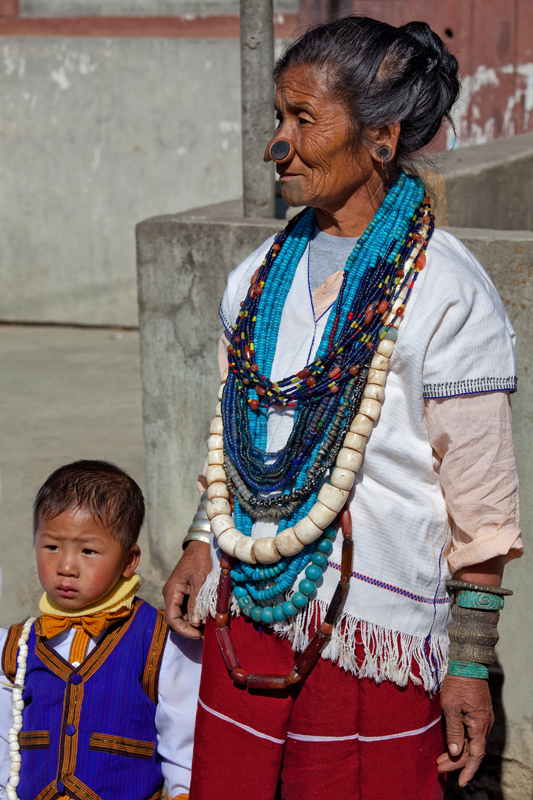
There are around twenty major tribes and many sub tribes in Arunachal Pradesh, India, and so it is no wonder that there is a big variety of tribal jewelries in this region. Anyway, you can notice some similar elements: practically in all tribes women wear numerous necklaces, bangles and belts. Headbands too are rather common.
Multicoloured strings of glass or stone beads are most favouvered but in southeast Arunachal Pradesh beads of agate stone, brass, and silver are also used. Such necklaces adorn the necks not only of women but sometimes of men as well. Every bead has its own value according to its colour and lustre. Usually they are worn in numerous quantity.

5.12.12

Beads in the ethnic jewelry of Africa

Samburu woman. Photo credit Sankara Subramanian

Beadwork is the most popular form of adornment among many Eastern and Southern African people. In earlier times beads were made from ostrich-eggshell, wood or bone but in the 19th century coloured beads from Europe came to the continent and tens of thousands of them began to be used to make amazing ornaments. These ornaments started to play an important role in social life of tribal people of Africa.

22.11.12

Stretched ears, a symbol of beauty and high status

photo credit Eko Prianto/CIFOR

The Dayak of Borneo used to be easily recognized by their very much stretched earlobes. In the baby age their ears were pierced and small brass rings were placed in the holes. Then very gradually more and more rings were added with time which caused the earlobes to stretch more and more and the holes bigger and bigger. The more stretched earlobes a woman had the higher status she had in Dayak society (because usually the most stretched ears would have the oldest women). Besides the status thing the stretched ears were considered beautiful. But it is a dying practice now, younger women don't want to do this anymore.

31.10.12

Pogo, a traditional adornment of the Khakassian women


In south Siberia there is a small republic called Khakassia. As in many other countries married Khakassian women traditionally has a special adornment which signals about their married status - pogo. It is really impressive and looks a bit like a bib embroidered all over with beads, corals and mother-of-pearl. Pogo are highly formalistic in shape, size and decorative style. The central pattern is formed by the large mother-of-pearl circles or buttons easily recognizable as the eyes, nose and ears. A genuine pogo was always a costly garment. It used to be given as a dowry, and years were spent saving up to buy the corals, semi-precious stones and mother-of-pearl for its decoration.

18.10.12

Perak, a traditional headdress of the Ladakhi women

photo credit Sandro Lacarbona

Some time ago in one of the jewelry shops of Kathmandu I saw something unkown to me and looking very unusual. As it turned out it was a perak, the head ornament of women of Ladakh, India. I was curious to find out more about this amazing headdress.
The perak is a status symbol for a Ladakhi woman, her wealth and position are shown by the number and quality of the stones decorating it. Turquoise is the perak's dominant element. In fact, the word "perak" is said to be derived from the word "per", an old Ladakhi term for turquoise.
The perak is worn by young girls starting at the age of five or six, but these are small and simple. The full perak is worn by a married woman as her most valued possession, if possible, untill old age. The value of the perak's turquoise stones acts as a form of old-age security. The perak also has a practical function: it protects against cold weather.