Showing posts with label traditional costume. Show all posts

27.4.19

Traditional costume of Belarus by region

Traditional costume of Belarus Western PalesseSummer male and female costumes, Pinsk district of Brest region, Western Palesse

The territory of Belarus is subdivided into six historical and ethnographic regions with specific features of traditional costume. Besides, costumes from different districts of the same region have their unique and characteristic features and vary in their decoration and ornament or in the way of styling. But the basic pieces are similar on the whole territory and let's have a look at them first.
Historically traditional clothes of Belarus people were almost completely made of home-made fabrics and decorated with woven and embroidery ornament. Flax and hemp were cultivated on the farms and widely used for making clothing along with wool and leather.
The basic component of both male and female costumes is a long linen shirt. Women wear a skirt over the shirt which is made from woolen, half-woolen or linen fabric and has different names - andarak, spadnitsa, yupka. It is constructed of several pieces of cloth sewn together. The ordinary type is sewn from three, four or six pieces that are gathered or pleated into the waistband. The paniova, the earliest type of skirt, consists of pieces of cloth, often four, which are attached to the waistband but unsewn at the sides.

3.4.19

Cambodian Apsara dance costume

cambodian apsara dancer

Recently I have visited Cambodia and while being impressed by the architectural wonders of the Angkor Wat I was absolutely captivated by the Cambodian Classical Apsara dance. This dance is very slow and delicate and every gesture and pose is full of effortless grace and beauty. And not only I was charmed by the dance itself but by the costumes of the performers.
Apsaras are celestial dancers who entertain the gods and kings in Hindu mythology. They are spirits representing water and clouds (since the fluidity of the dance). The power of Apsaras over men is beyond comparison as both mortals and divinities cannot resist the charms of the celestial dancers. The Apsara dance already existed in the 6th-7th centuries. Hundreds of Apsaras are depicted on the stone carved walls of the Angkor site, especially in Angkor Wat and the ancient city of Angkor Thom and costumes of the present day Apsara dancers are based on those carvings.

21.1.18

Huipil, the artwork in everyday use

women from Chiampas, Mexico wearing traditional huipil
Women from Chiampas region of Mexico wearing huipils, photo courtesy PWRDF

Some time ago I visited an exibition of Mexican textiles from the Chiapas region of the country and I was striked by the beauty of huipil - the traditional dress of the Mayan women - as well as by their skills in embroidery. To think about it: a rectangle of cotton with an opening for the head...what can be simplier? This design has been popular in different cultures for centuries . But add some love, creativity and skills to this simple practical piece of clothing and it turns into a work of art.

19.4.16

The Art of Kimono

Japanese girl in kimono photo courtesy Stefan Schlautmann

One of the things that I would definitely like to try on one day is a kimono. Such a simple in its construction garment yet so beautiful and elegant it looks on a woman. And the prints and motifs that decorate some special occasion pieces? They are simply fascinating, real works of art decorated with brush painting, embroidery, tie-dyeing, applique and even with gold and silver.

1.4.16

Court dress in Burma, Nepal and Sri Lanka

19th century court dress in Burma, Nepal and Sri Lanka

Throughout history there has always been significant difference between the costume of nobles and that of ordinary people. In many countries there were special laws that dictated what could or could not be worn by who. For those who appeared at court requiries were even more specific and more strict. My today's post is about interesting examples of court dress in the 19th century Burma, Nepal and Sri Lanka.

11.2.16

Peranakan traditional wedding dress

Peranakan bride and groom in traditional dress
photo courtesy Wyndson 

 During my last stay in Singapore a few months ago I visited the Peranakan Museum and was really impressed with the amazing examples of peranakan handicrafts: beadwork, jewelry and textiles. A whole chamber of the museum was dedicated specifically to Peranakan weddings and I have to say that their wedding ensembles are one of the most beautiful, colourful and rich ones that I have ever seen. First of all, who are the Peranakans? The term Peranakan generally refers to people of mixed Chinese and Malay/Indonesian heritage. Many Peranakans trace their origins to 15th century Malacca where their ancestors were thought to be Chinese traders who married local women. The Peranakans were also known as Straits Chinese as they were usually born in the British-controlled Straits Settlements of Singapore, Penang and Malacca. They combined the elements of the Chinese, Malay and sometimes European culture into their own.

28.1.16

The palm leaf hat of Vietnam


When I was on holidays in Vietnam I felt it would be such a pity to be there and not to try wearing something Vietnamese. Alas, the choice was not that big. Their traditional dress, ao dai, was not available in a ready-made variant and I was just too lazy to be bothered ordering it at the tailor's. So, the only other thing left was their traditional palm-leaf hat, nón lá. Especially considering that it cost almost nothing and was available literally at every corner.

Vietnam street food

Vietnamese woman wearing conical palm leaf hat

This conical is a symbol of nation, the item that can be easily recognized at any part of the world as Vietnamese. These hats have been made by peasants from time immemorial. The popularity of it can be explained by the availability of the palm leaves and bamboo from which the hats are made from, by the simplicity of the construction techniques and by the multi-functionality of the hat itself. It not only offered protection from the sun and rain. It could serve, for example, as a fan, as a basket to hold things when shopping or as a water container for drinking. However the shape of a hat and the material it was made from depended on the owner's social position: different kinds of hats have been made for soldiers, mandarins, monks and even for kings.

Vietnamese man on a bike wearing palm leaf hat

Vietnamese Soldiers statues at Khai Dinh Emperor's Mausoleum, Hue, Vietnam Vietnamese Soldiers in conical hats statues at Khai Dinh Emperor's Mausoleum, Hue, Vietnam. Photo source

Besides, this simple conical hat plays important role in tradition of worshipping Holy Mothers. The Holy Mothers are worshipped in small temples and shrines that are sometimes built behind a pagoda. They symbolise the universe's four worlds: Heaven, Earth, Water, and Mountains and Forests. On the ceilings of the temples and shrines dedicated to the Holy Mothers hand many conical paper hats of four colours representing the four Mothers: red for Heaven, white for Water, yellow for Earth and green for Mountains and Forests.

Kate Moss wearing Vietnamese hat, 1996Kate Moss by Bruce Weber for Vogue US June 1996. Photo  source

What are my personal impressions of wearing this hat? I can say that it is the best choice of a head cover to wear in such climate: it is light and being made of natural material it gives perfect protection from the scorching tropical sun without making your head sweating underneath. 


I wore it during our excursions to the ancient town of Hoi An and to the jungles of My Son, I wore it on the beach. Perhaps I didn't look that glamorous in it but still I felt gracefull enough and comfy. And yes, very Vietnamese.

You might also like


8.10.15

Kokoshnik, a symbol of Russia

photo source

Who hasn't heard about kokoshnik? Now and then one can see kokoshnik-inspired modern creations on podiums and in fashion magazines. I believe it is the most known and recognisable garment of a traditional female costume of Russia. This very elaborate married woman's head-wear was common in the northern and central provinces of Russia and was worn on everyday basis as well as on festive occasions.

6.7.15

Beautiful Japanese dolls in traditional dresses


Some time ago there was an exhibition at the Japanese embassy dedicated to traditional dolls of Japan. Couldn't miss it because firstly, still have this childish weakness for dolls; second, Japanese dolls are really something special, they were created not as toys for children but like some type of art to admire; and third, those dolls are dressed in traditional clothes which would never fail to arouse my interest. Besides, Japanese culture has always been fascinating to me. At the exhibition I could not only enjoy the beautiful dolls but find out something new from the information written on the stands.

20.2.15

Tibetan and Sherpa costumes at Lhosar celebration

Sherpa girls wearing traditional dress

Yesterday it was Lhosar - Tibetan and Sherpa New Year. It is one of the most important festivals for Tibetan Buddhists and at this day people try to visit one of the sacred sites. They usually dress up for the occasion and dressing up in this case means wearing traditional costume. Some like classic variant, while others prefer more modern versions. I am not a Tibetan Buddhist but I like to go to the places of celebrations at this day too, just to enjoy the festive atmosphere, to watch people, to admire all those colourful costumes.

17.2.15

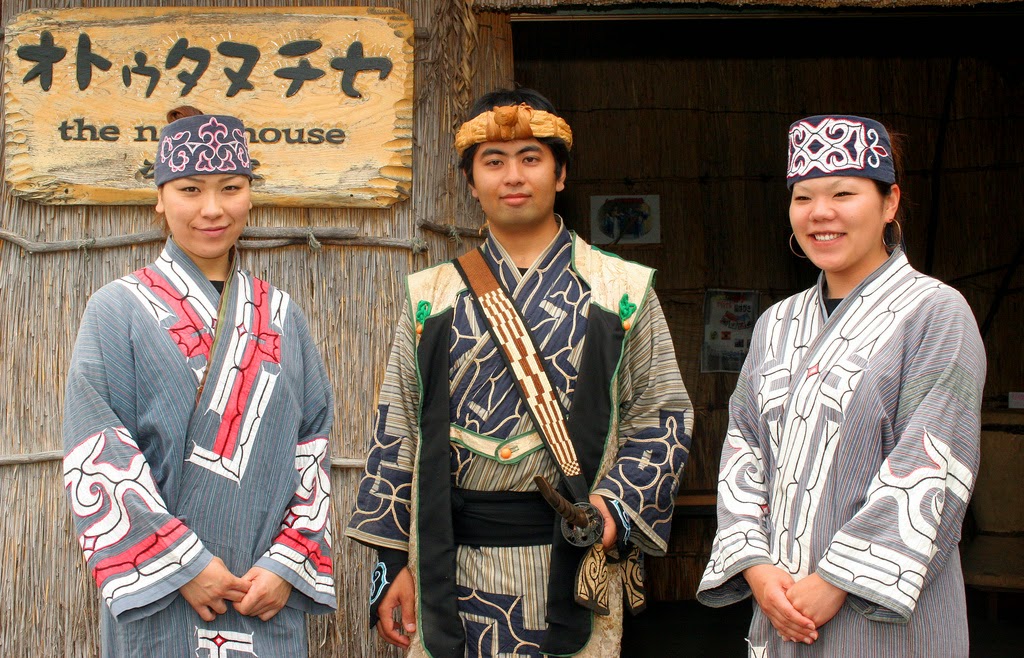
Ainu people costume and jewelry

Ainu wearing traditional costumeAinu wearing their traditional costume, photo courtesy  Roderick Eime

Have you ever heard about Ainu? Well, in case you haven't, they are indigenous people of Japan who used to live all over its territory in ancient times but not much of them are left now and nowadays they live mainly on Japanese Hokkaido and the Kuriles and southern Sakhalin Island of Russia. I decided to dedicate a post to this small ethnic group because the main element of their traditional costume, a robe worn by women and men alike, is considered one of the most unique and distinctive pieces of clothing in the world of ethnic dress. First, interesting were materials which Ainu originally used to create these robes: they could be made of plant fiber - bark of elm trees, for example; of animal fur/skin - dog's, bear's, seal's; of bird skin and feathers and even...of fish skin. Can you imagine a wearable robe made from fish skin? Honestly, I can't. But it turns out that garments made of fish skin are strong, light, durable and waterproof. Amazing, isn't it? It seems Ainu used all the nature resources available. Of course, nowadays nobody makes clothes from such unusual "fabrics" any more, with time cotton and silk started to be used, though traditional "bark" robes are still can be found.

6.1.15

Jamawar, the woven jewel of Kashmiri shawls

pashmina jamawar source

Who hasn't heard of Kashmiri shawls? They are world famous for their exquisite softness of material and beauty of design and colour. Of all the types of Kashmiri shawls the most complex, most beautiful and most expensive is the jamawar shawl which is often referred as "woven jewel". Jamawar has always been associated with fine taste, luxury and grandeur and have been passed on as heirlooms in many of India's old families. These shawls were originally worn by noble men in India and Persia. They used to be gifted by rulers to favoured diplomats, or courtiers in gratitude for services, successes, or loyalty. Jamawars woven by Sufis were used for prayers, as table-clothes and spreads during religious festivals.

12.12.14

Turkish beauties of the 1930s in traditional costumes


Baggy salvar pants, front-opening fitted gown entari worn over a chemise or shift, long-sleeved short jacket mintan, outer robe kaftan, small pillbox hat and large veil, woven sash - those are the elements of traditional woman's dress of Turkey that can be seen on these vintage 1930s photographs. Compromise between emerging western and traditional Ottoman ideas however is also noticeable: the dress is traditional, but not entirely.

24.6.14

Traditional costume of the republics of Central Asia

Girls at the National Dress Festival, Uzbekistan, representing Tashkent and Fergana. Photo  source

I've already written about ethnic jewelry of the republics of Central Asia and today's post is about their traditional costume.
Traditional costume in Central Asia is still very much alive and worn in everyday life, partly because it is the most practical wear for this region and partly because it fosters national pride.
The costume worn by men and women has same basic structure and at the same time greatly varies in embelishment, colour and weave of cloth. The three basic pieces are: a tunic, trousers and a variety of coats. Social status and ethnic origin are reflected in the materials from which the basic garments are made. Man's tunic usually comes just below the waist, women wear a longer version that reaches to mid-calf or to the ankle. The colour, pattern and decoration varies from group to group.

29.5.14

Nepali kids in traditional outfits, part two


The post "Nepali kids in traditional outfits" is quite popular in my blog. So, here is part two with new photographs. This little beauty in green sari, as well at the one on the photo below, were spotted during a street festival. They were sitting at the stall collecting donations for a temple. Of course, nobody could just pass by seeing these lovely girls.

22.5.14

Top three ethnic skirts

There are varieties of beautiful skirts of different design in ethnic world. Today I want to show you three of my favourite ones from different parts of the world. 1. The skirt of a thousand pleats. This skirt is a part of traditional costume of Flower Hmong women living in Vietnam. It is said that the skirt was inspired by an open latania leaf. For pleating the fabric of approximately 5 m wide and 70 cm long is used. The skirt is made up of three rows. The first is in plain indigo hemp fabric; the second is also hemp decorated with batik patterns. Then comes a band decorated with appliques in traditional designs - roses, apple blossom, peonies or cranes. Though the skirt is known as "the skirt of a thousand pleats", the real number of pleats is two hundred or so. Pleating is done by hand, a mixture of water and rice starch is poured over it and then left for a month. After that the top of the pleats are secured by stitching.

Flower hmong people pleated skirts
photo courtesy  Brian Snelson

15.5.14

Guatemala's men of style

Man from Solola. Photo courtesy  Thomas W

When I write about traditional costumes it is usually women whose amazing clothes and jewelry I describe. Because in ethnic as well as in modern world men's costumes are usually less interesting and less impressive than those of women. Men traditionally prefer something more modest, more simple and more sophisticated. But in Guatemala there are still many villages that are worth visiting just to see the men who live there. Because their costumes would surely impress anyone with their brightness and uniqueness. Besides, the men wear them not for tourist entertainment or only on festivals or special occasions but in everyday life. These men are Mayan by origin and wearing traditional clothes is their way to demonstrate their pride in being Mayan.

5.2.14

Dressed to welcome Spring


Spring has officially started in Nepal. Yesterday was the festival here called Basant Panchami which marks the beginning of spring ("basant" literally means "spring") and at the same time, it is a festival dedicated to Saraswati, Goddess of knowledge, wisdom, arts and music. Saraswati is supposed to celebrate her birthday and at the same time she opens the doors of the spring season. People, mostly women and schoolchildren, pay homage to the image of Saraswati and sprinkle the goddess' image with grains, flowers, fruits and sweets. Look at the beauties in traditional attires that I caught with my camera.

5.1.14

Traditional wedding costume and headdress of Europe

I have told you about traditional wedding costumes of India and Sri Lanka, about unique bridal jewelry of Indonesia, Nepal and Morocco. They are so beautiful, exotic and unique that honestly, the European white wedding dress seems a bit plain and boring. But...it has not always been like this. For most European countries a national costume in its most decorated form was worn as a bridal dress and some garment was added to indicate the girl as the bride, usually it was an elaborate headpiece. And what headpieces they were! A variety of colours, fabrics, textures and even precious jewels was used for bridal headdress.

Bride and groom from Bulgaria, vintage photo
Bride and groom from Bulgaria

In Bulgaria complicated arrangements of woolen braids and bunches of flowers were fastened between the bride's own hair which was plaited in a dozen or more braids. In parts of the Sofia region a bride would wear a huge halo of flowers and bunches of feather grass and her face were hidden by a curtain of numerous thin plaits hung with coins. And in Pleven region brides wore impressive halos of coins. A bridegroom would be distinguished by the white towel placed over one shoulder or around his neck and the posy of flowers or the wreath on his fur hat.

24.10.13

Traditional dress and adornments of Ndebele

photo source

Today I am taking you to Africa again. On the south of the continent a tribe lives women of which have very interesting traditional costume and adornments. The tribe's name is Ndebele and they are famous around the world for their traditional wall painting art. Researchers say that probably the coloured geometrical patterns of the wall paintings are derived from the more ancient ornamental tradition of decorating women's clothing.