Showing posts with label India. Show all posts

19.8.15

Women tattooing in India

photo courtesy Meena Kadri

In the tribal regions of India tattooing remains a widely spred tradition, especially in the central and northeastern regions of the country. It is interesting that the practice is more prevalent among women. In some communities tattoos are essential for marriage; in others the number of tattoos is indicative of the bride's economic status; and in some places a man will not touch or accept food from a woman who is not tattooed on her feet. The main purpose of tattooing, however, is protective, the tattoo acts as defense against the forces of evil that are  believed to be constantly active and attempting to gain advantage over the unprotected humans causing misfortune, illness or death.

14.6.15

Ethnic jewelry of Ladakh

Ladakhi woman wearing ethnic jewelryphoto courtesy  Dietmar Temps

Ladakh is a dry, high-attitude region in the Indian state of Jammu and Kashmir and its people have a highly distinctive style of dress and very unique and interesting jewelry. The most recognizable ornament of Ladakhi women is a turquoise studded headdress called perak. There is a post on my blog dedicated exclusively to the perak (here ) and in my today's article I want to tell about other jewelry worn by Ladakhi women. Perak, being an impressive ornament on its own, additionally serves as a perfect display for numerous other hanging jewelry pieces that can be attached to it. Those who can afford it attach a separate piece of cloth to the left side of the perak decorated with up to ten vertical lines of coral ending in cowrie shells. To hold the perak in place silver chains are used. Below the chains hang flat silver plaques, usually with an endless knot motif - the auspicious and luck-bringing design, one of the Eight Auspicious Emblems of Buddhism - from which dangle small bells.

6.6.15

Jewelry for Hindu deities

Hindu Goddess adorned with jewelry, Sankhu, Nepal
Adorned image of Khadga Jogini Goddess of Sankhu, Nepal

In Hinduism images of deities are traditionally decorated with jewelry. According to Hindu belief all precious metals and gem stones are believed to be ritually pure and any pollution or contamination they may catch is removed simply by washing. So such adornments are suitable for deities decoration.
The purpose of adorning the deity image with jewelry is to impress the mind of the viewer to whom such a show of wealth is awe inspiring.

11.3.15

Indian jewelry: meenakari

Meenakari pendant. Northern India, 18th century. The Museum of Fine Arts, Boston

The art of enamelling is called meenakari in India. It was introduced by the Mughals during the seventeenth century. Later skilled meenakars from the Mughal palace were brought and established in Jaipur, which became the centre of meenakari work. Today there are two major jewelry enamelling centres in India with its own distinctive traditional style of work: Jaipur and Benares. The highest quality enamelled jewelry still can be found in Jaipur and some of the finest work being made today is comparable in every way with the best of the Mughal jewelry.

6.1.15

Jamawar, the woven jewel of Kashmiri shawls

pashmina jamawar source

Who hasn't heard of Kashmiri shawls? They are world famous for their exquisite softness of material and beauty of design and colour. Of all the types of Kashmiri shawls the most complex, most beautiful and most expensive is the jamawar shawl which is often referred as "woven jewel". Jamawar has always been associated with fine taste, luxury and grandeur and have been passed on as heirlooms in many of India's old families. These shawls were originally worn by noble men in India and Persia. They used to be gifted by rulers to favoured diplomats, or courtiers in gratitude for services, successes, or loyalty. Jamawars woven by Sufis were used for prayers, as table-clothes and spreads during religious festivals.

17.12.14

Indian wedding party

Me in my party outfit

In the beginning of December we were invited to a wedding in Jaipur. This Indian city is like a dream itself and to attend a wedding there would be like to find oneself in a fairy-tale. I especially want to see a groom arriving to the bride's house on an elephant. The invitation, actually four of them for each day of the four-day-long celebration, is one of the most beautiful I've ever received.

17.7.14

A reversed Cinderella story

Indian party lehenga and red embroidered kurta

Bollywood movies are commonly known for their unrealistic love stories that could hardly happen in real life. But let me tell you a real life story that sounds no more realistic than any Hindi movie or a fairy tale. The story happened in the second half of the 19th century in Kapurthala that was a Princely State of Punjab at the time. Princess Gobind Kaur was a daughter of Maharajha of Kapurthala and since childhood had lived in great luxury and splendour of the court of her father. She was married at the age of 12 to a nobleman of great wealth and position. Thanks to her royal status she didn't have to move to her husband's house as tradition required but stayed at her own six-storeyed palace. Nevertheless the life there was pretty boring.

2.7.14

Indian designers: what to wear this summer

I guess not many of you are familiar with Indian designers. There are a lot of them who create not only ethnic Indian dresses but very interesting designs that can be worn by any woman anywhere in the world. Here are a few works by different Indian designers from the 2014 collections. The choice was made according to my personal liking, I would gladly wear any piece of the shown clothes.


I am not a big fun of bugs but this insect-inspired dresses by Jenjum Gadi do look appealing to me.

10.4.14

Sari forever

Pastel floral sari

For some official events here in Nepal wearing a sari is a must for all the invited women including foreigners. I love sari, it is such a feminine, elegant and undoubtedly beautiful variant of traditional Indian dress. Literally speaking the sari is just a piece of fabric of about 4-8 m long and about 120 cm wide. And it is amazing that by draping it around the body it can be transformed into such a beautiful item of women's clothing. Of course, draping a sari requires experience and skills. And that is exactly what I lack. Theoretically I know how to drape it but practically it just doesn't work that smoothly and I have to re-drape it again and again. As a result draping a sari takes so much time for me. And I get tired and often annoyed in the process. But the final look is worth all the effort I guess.

20.3.14

Indian jewelry: thewa work

Thewa brooch, 19th century, Chased gold over blue glass, set in gilt silver. The Victoria and Albert Museum

Another type of traditional Indian jewelry that I want to tell you about is thewa (another spelling is theva) work. This technique is unique not only to India but to only one its region - Patrabharh town in Rajasthan. Nowhere else in India this skill and fine expertise exists. It was invented in 1767 by a local goldsmith. The technique has been kept secret since then and knowledge of theva work passed from father to son who start learning it at an early age. At present there are four families of goldsmiths in Partabgarh who carry on with this tradition.

27.2.14

Modern life of traditional Indian textiles

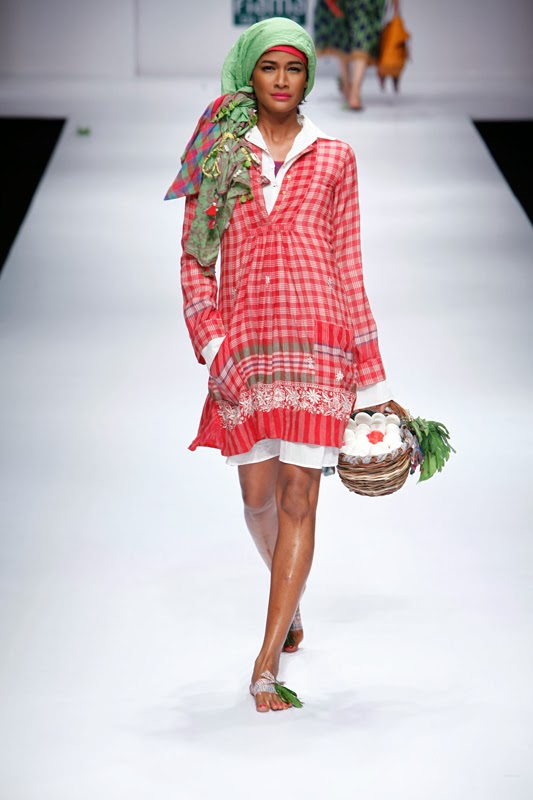
Madras checks dress by Aneeth Arora

India has tremendously rich and varied textile traditions. Every technique has been practiced for centuries, with an instinctive sense of proportion, colour and harmony. Each of India’s states - and many of the villages within those states - has its own distinct designs and techniques with an instinctive sense of proportion, colour and harmony. These fabrics have been used for ethnic clothes for centuries but recently contemporary designers (and not only Indian) have shown interest in traditional textiles too and started using them in their creations. And now these vintage weaves fused with modern designs found their way on podiums and in fashionable boutiques. Here are a few examples.

27.12.13

Zardozi, the ancient art of metal embroidery

photo source

If you have ever seen an Indian bride wearing a traditional wedding outfit, you couldn't help noticing the elaborate embroidery that her dress was richly decorated with. It is the famous zardozi style. This ancient art has been mentioned as far back as the Rigveda, where it has been described as the attire of gods. It used to be a privilege enjoyed only by aristocrats and royalty. Maharajahs wore ceremonial cloths decorated with zardozi; elaborate panels were hung on their walls and for ceremonial processions their elephants and horses were adorned with zardozi spreads and saddles.

29.5.13

Jewelry and dress of the Maharajahs of India

Maharajah Umaid Singh of Jodhpur, 1920

Today I want to tell you about the dress and jewelry of the Indian Maharajahs. Those guys liked to dress up and were not shy of wearing necklaces, armlets, bracelets and ornamental belts. The purpose of such grandeur was to show their majesty and to indicate the richness of their treasury. Often their costumes and accessories were more elaborate than those of their wives.
Most of them had an astounding collection of jewelry. Many of them had access to private diamond and gold mines and, thanks to that, over the years built up incredible and unique collections of jewels .

17.4.13

Tribal jewelry of Orissa

photo courtesy Rita Willaert

I continue to tell you about ethnic jewelry of different states of India. Today's post will be about tribal jewelry of Orissa. Of all the states of India, Orissa has the largest number of tribes, as many as 62. Each of these tribal groups has its own distinctive adornments but I will tell about the most typical and interesting ones. The Bondo tribe is the most spectacular tribe of its kind in all India living in the wild hills in the south of Orissa. Bondo means "the naked ones", a name given them by the Indians of the plains. According to legend, Bondo women were condemned and a commandment forbids them either to grow their hair or to wear any clothing apart from a home-woven loincloth.

4.4.13

Unique headdresses of the men of India

photo courtesy Raj Kumar

Previously I posted about interesting headdresses of different ethnic groups but those were always woman's headdresses. Today I want to correct the injustice and write about unique headgear that men wear and for the start it will be about men of India.
One of the most impressive headdresses are worn by the men of Nagaland. According to Nagas the head is the most important part of the human's body as one's soul dwells in there. The materials, colours, manufacture and the manner in which each Naga tribal headdress is worn distinguish tribe from tribe and bond the wearer to the ideal clan image.

13.3.13

Indian jewelry: modern pieces


If you ever find yourself at a real Indian party you will be amazed not only with the richness and brightness of the women's outfits but you will also be bedazzled with the jewelry they wear at such occasions. Here are a few photos I took at different Indian parties that I was lucky to attend. It is always entertaining for me to look at the jewelry that women wear, all different in design, massive, made of solid gold or embellished with precious stones and enamel.

9.2.13

Tribal jewelry of Himachal Pradesh

photo source

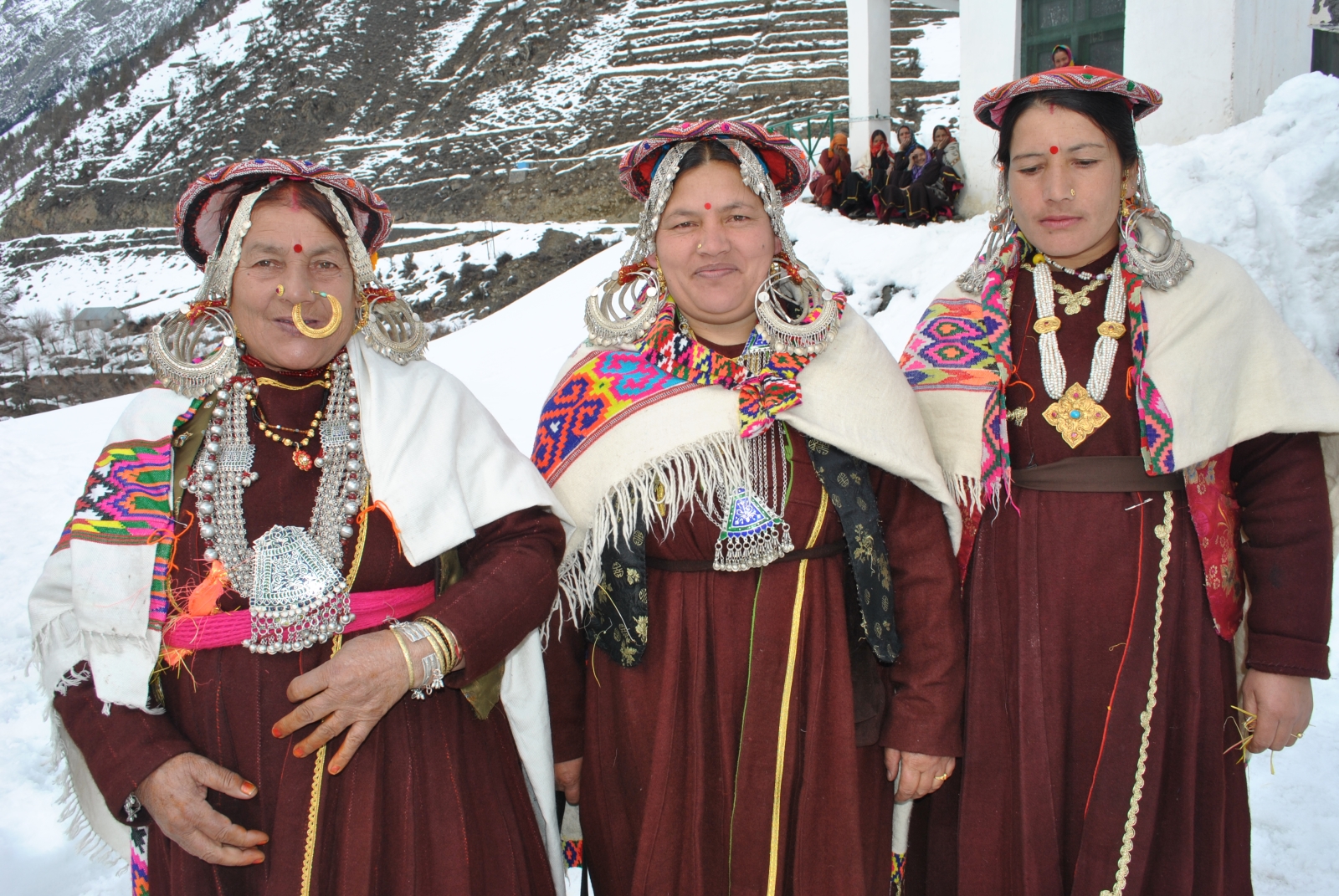
Today I want to write about tribal jewelry of another region of India, Himachal Pradesh. This area is inhabited by the Buddhist of Lahul and Spiti, the Hindu Gujjar and Bakarwal nomads, and the Hindus of Kullu and Chamba. Designs of many ornaments here is of Indian origin mingled with those of Tibet. Many jewelry motifs are inspired by nature: a flower of lotus, leaves of a pipal tree, a tiger's head.
One of the most popular ornament in Himachal Pradesh is a head ornament. The most common one is the bindi which has a central pendant hanging from the parting of the hair and silver chains extending on both sides upto the ear. A set of attractive items for the forehead is called shringar-patti. It includes a fringe worn on either side of the face, consisting of a star or geometrical shaped pieces linking to each other. Hung from it are pipal leaves or stars or drops. There are also moon or crescent shaped plaques sometimes enameled, suspended on to the middle forehead.

22.12.12

Tribal jewelry and adornments of Arunachal Pradesh

Apatani woman

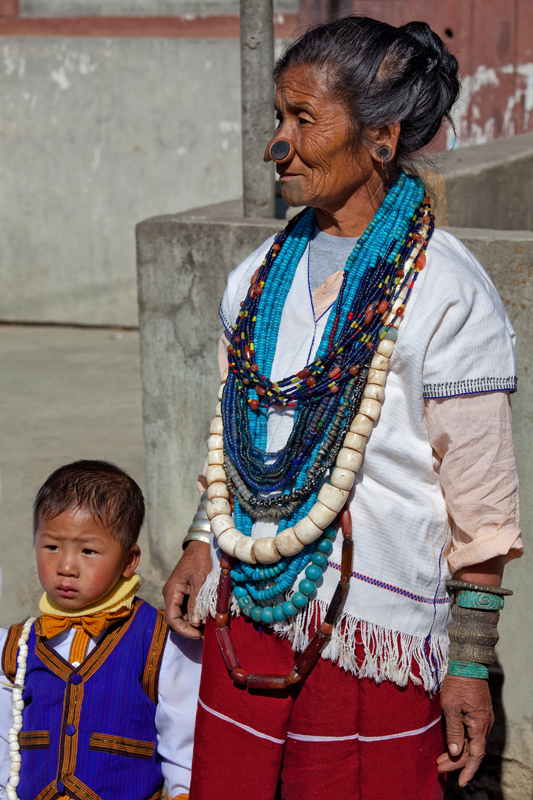
There are around twenty major tribes and many sub tribes in Arunachal Pradesh, India, and so it is no wonder that there is a big variety of tribal jewelries in this region. Anyway, you can notice some similar elements: practically in all tribes women wear numerous necklaces, bangles and belts. Headbands too are rather common.
Multicoloured strings of glass or stone beads are most favouvered but in southeast Arunachal Pradesh beads of agate stone, brass, and silver are also used. Such necklaces adorn the necks not only of women but sometimes of men as well. Every bead has its own value according to its colour and lustre. Usually they are worn in numerous quantity.

14.12.12

Such different Indian brides

Indian bride in traditional wedding dress
photo credit  Raj Kumar

When being asked about an Indian bride most people would portrait her in red sari with lots and lots of golden jewelry. That is a typical image of a Hindu bride. But in reality it is not quite so because in different parts of India brides wear different kinds of clothes, ornaments, and adornments that are usually typical of the area. A Rajasthani bride would wear a lehenga, a Punjabi bride would wear a salwar-kameez, and a Maharashtrian bride would wear a nine-yard saree. The costume is usually in shades of red, pink or mustard. Like her clothes, the bride's ornaments also differ according to local tradition.

9.12.12

Traditional dress of the Rabari


First time I got to know about Rabari was when browsing the internet I accidently found a photo of a rabari girl in festive costume. The dress and the adornments of that little princess simply delighted me and I decided to make research and to find out more about these people and their traditional costume.
Semi-nomads in the Thar Desert in the Indian states of Rajasthan and Gujarat, the Rabari are a tribe of about 400 000 people. They are known for impressive embroidery which is very vigorous, with many bold shapes. Designs are taken from mythology and from their desert surroundings. They use glass mirrors in various shapes: round, lozenge, rectangular, square, triangular, and beak shaped. Rabari women decorate with embroidery literally everything: their own clothes, men's clothes, children clothes, bags.